Project 2
Moffitt Cancer Center
∆ Stromal Ecology: Project 2
Project Overview
Despite eliciting strong and durable responses, therapies targeting oncogenic signaling of mutant receptor tyrosine kinases such as ALK and EGFR eventually fail in patients with advanced non-small cell lung cancer (NSCLC). This failure reflects the ability of some tumor cells to avoid elimination, persisting within minimal residual disease (MRD). Over time, these persisting populations adapt through genetic and epigenetic changes, amplified by Darwinian selection, eventually leading to true resistance and relapsed tumor growth. While persistence can reflect cell-intrinsic properties, a growing body of evidence points to the importance of stromal paracrine factors that contribute to MRD by blunting the impact of targeted inhibitors. Resistance is generally considered cell-intrinsic, with mutational mechanisms enabling tumor cells to survive independently of stromal sheltering; however, the probability of these mutations is likely enhanced by cell proliferation within protected niches. Conversely, stromal sheltering might suppress the expansion of intrinsically resistant clones by enhancing competition from sensitive cells within stromal sheltered niches.
Approach and Preliminary Findings
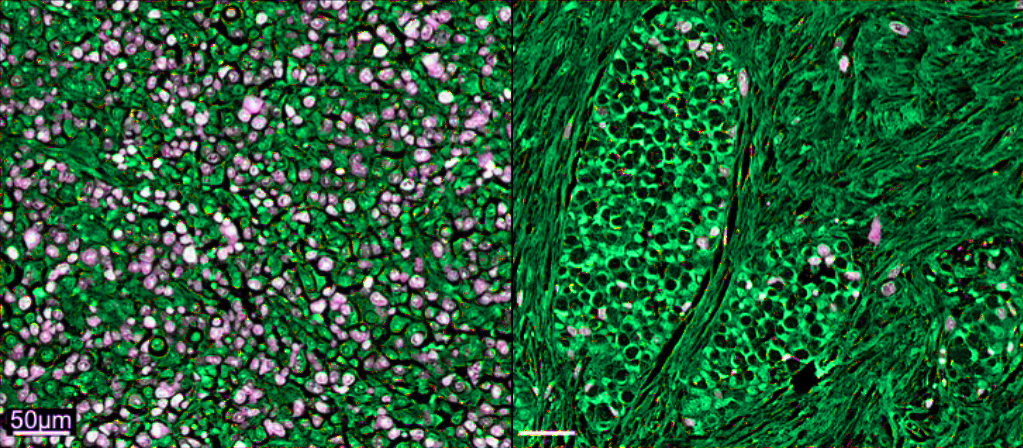
In our preliminary studies with xenograft models of acquired resistance to the frontline ALK inhibitor alectinib, we have observed surprisingly strong and multifaceted effects of stromal sheltering. Whereas alectinib strongly suppressed tumor cell proliferation, proximity to stroma partially counteracted this suppression, with the magnitude of the effect and size of protective niches changing over the course of treatment, reflecting progressive changes in both neoplastic and stromal compartments. Our objective is to integrate consideration of cell-intrinsic and cell-extrinsic inputs that shape the evolution of therapy resistance in vivo. Since this integration is impossible within traditional reductionistic paradigms, we will perform system-level characterization of the phenotypic progression of interacting tumor and stromal compartments and capture the spatiotemporal proliferation/death dynamics of evolving tumor cell populations using in silico modeling approaches. Once validated, these models will enable us to search for therapeutic interventions that optimize long-term outcomes.
Aim 1: Characterize spatiotemporal delta ecology of acquired resistance
We use advanced mouse models of ALK+ and KRASG12C NSCLC to study how tumors acquire resistance to targeted therapies over time. By integrating bulk and spatial transcriptomics, functional genomics, and digital pathology with lineage tracing using Ecological Analysis Core tools, we chart molecular and clonal changes in both tumor and stromal compartments. Experimental results guide the construction of spatial agent-based models that simulate eco-evolutionary tumor-stroma interactions during remission and relapse.
Aim 2: Define the impact of stromal sheltering on the emergence of resistance
Leveraging in silico models and controlled experiments, we assess how stromal sheltering affects the likelihood and speed of resistance mutations as well as competition among resistant and sensitive tumor cell populations. Using genetic algorithms paired with model-informed predictions, we optimize and test new therapeutic strategies—including cycles of stroma-targeting combination treatments—to sustain remission and delay resistance evolution in NSCLC.
Aim 3: Discover optimal therapeutic strategies to suppress the evolution of resistance
Starting with our existing ABM model and incorporating the insights from the above studies as they become available, we will use a genetic algorithm to explore the impact of different strategies of interfering with stromal sheltering on the duration of remission. Model-based predictions of optimal cycles of stroma-targeting combination agents on the backbone of continuous front-line therapy will be validated experimentally.
Jump to Project 1: