Mathematical Core

Moffitt Cancer Center
Core 1: Mathematical Core
Mathematical Modeling Approach
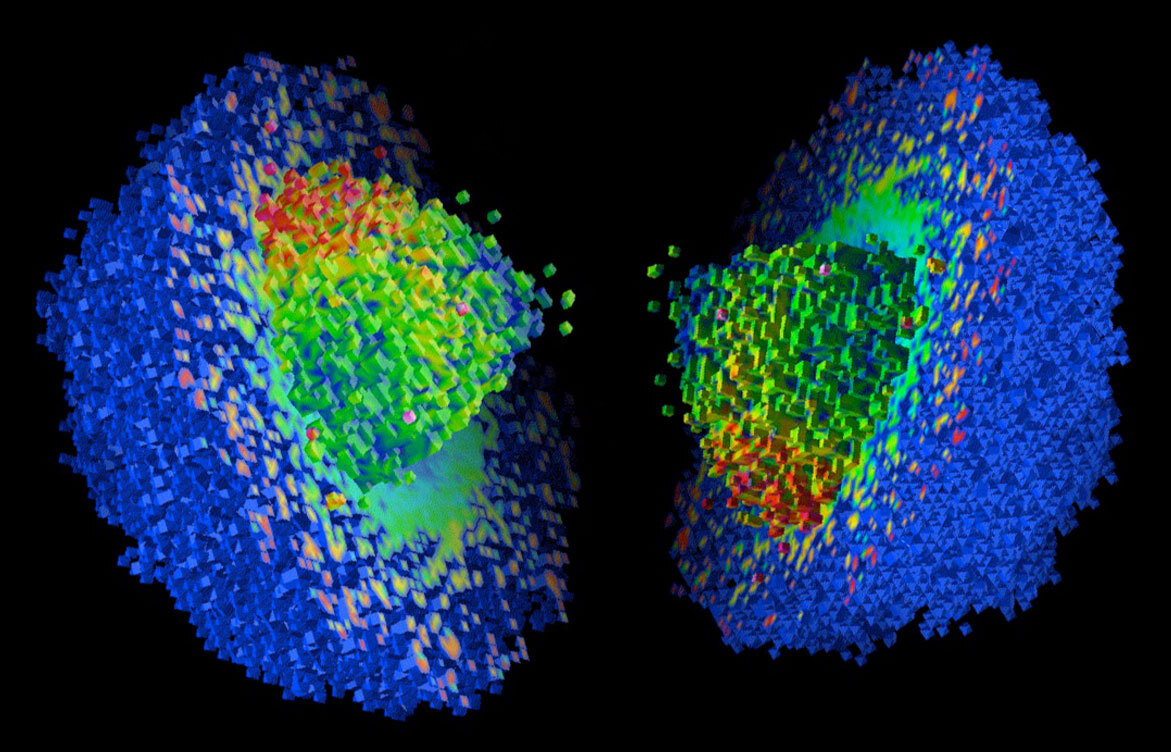
Cancer is driven by Darwinian dynamics that play out in the changing ecology of organ systems, forming unifying first principles through eco-evolutionary dynamics. The dominant challenges in understanding cancer dynamics and therapeutic response are analyzing data on dynamical components and building computational models that integrate that data within a Darwinian framework, including both ecological dynamics (changes in tumor burden and environmental conditions) and evolutionary dynamics (changes in cancer cell types and composition). Nearly 15 years ago, we initiated an innovative program at Moffitt Cancer Center by hiring mathematicians to explicitly add theory to empirical basic science and clinical investigations. The Integrated Mathematical Oncology (IMO) department, with 7 faculty mathematicians and 2 evolutionary biologists, has developed numerous models of tumor growth and treatment across diverse cancer types including prostate, lung, sarcoma, breast, skin, blood, brain, bone, and connective tissues. These approaches have yielded multiple mathematical model-driven cancer treatment strategies, many of which have been preclinically tested and some are actively in clinical trials. The Mathematical Modeling Core supports the development, analysis, and application of mathematical models needed for the proposal, serving as a key integrator of ecological ideas driven by mathematical models and facilitating dialogue between preclinical and clinical approaches.
Data Integration and Virtual Trials
Models are only as good as the data that drives them, and there is a significant disconnect between experimental and clinical data in terms of resolution, abundance, and timescales. Our goal is to exploit and integrate all available data in a patient- or animal-specific manner to calibrate, test, and validate our models. Temporal dynamics are critical for understanding ecological dynamics; however, this remains the largest gap in current data collection strategies, leading to uncertainties. We deal with this complexity and uncertainty by embracing it in the form of virtual patient cohorts. Comprised of different virtual patients (or mice) formed by different model parameterizations, we fit and refine these cohorts to understand the impact of heterogeneity, a process we term a Phase i trial. This approach allows us to bridge the gap between experimental and clinical data while providing rigor to logic, clarifying and testing hypotheses, and creating a lockstep between theory and empirical work.
Aims
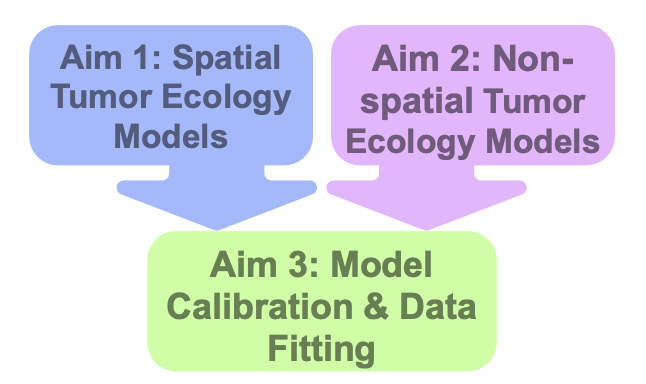
The tools and methods developed here will be generalized for use in both projects and will be derived from unifying ecological principles. We will build both spatial and non-spatial ecological models, and service them with calibration and analysis tools. This Core includes three specific aims:
1 Spatial mathematical models of tumor ecology
- Hybrid agent-based models and the HAL framework
- Modeling intracellular molecular dynamics of targeted pathways
2 Non-spatial mathematical models of tumor ecology
- Ordinary differential equation models
- Non-spatial ABM models of heterogeneity
3 Tools for interpreting ∆-ecology of therapy via models and data
- Mapping data into spatial models
- Parameter uncertainty and calibrating models to clinical and experimental data
- Analyzing and optimizing therapy regimens via Phase i trials
See other cores: